What Can an Air Purifier Remove,
and What Can't It?
From what HEPA, activated carbon, and pre-filters actually do to the pollutants no air purifier can remove — a guide to choosing with your eyes open.
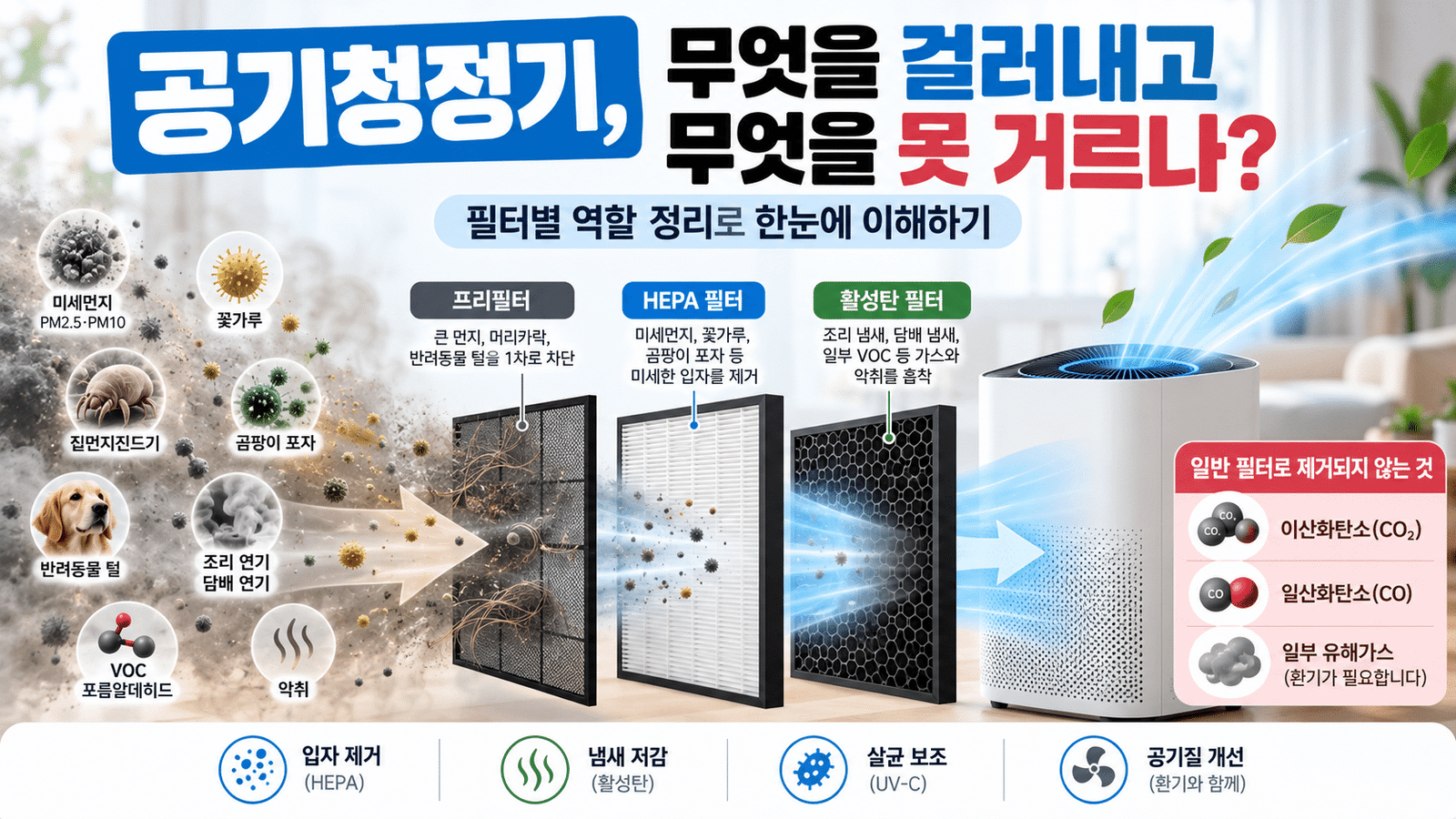
Air purifiers capture fine dust and pollen with high-efficiency particle filters such as HEPA, and reduce some odors and gaseous pollutants with activated carbon filters. A typical home air purifier, however, does not remove carbon dioxide (CO₂) or carbon monoxide (CO). Good indoor air quality comes from combining source control, ventilation, and an air purifier.
01. What Can an Air Purifier Remove?
Air purifiers are used to reduce airborne particles and some gaseous pollutants. The filter you need — and how well it actually works — depends on the type of pollutant.
| Pollutant | Can It Be Removed? | Main Method |
|---|---|---|
| PM2.5·PM10 Fine Dust | Yes | HEPA and other particle filters |
| Pollen & mold spores | Yes | Particle filter |
| Pet hair & dander | Yes | Pre-filter & particle filter |
| Particles in tobacco smoke | Yes | High-efficiency particle filter |
| Cooking odors & some VOCs | Conditionally | Activated carbon and other adsorption filters |
| Formaldehyde | Varies by product | Specialized adsorbent media |
| Carbon dioxide (CO₂) | Not with standard models | Ventilation |
| Carbon monoxide (CO) | Not with standard models | Source control & safety measures |
02. Comparing Air Purifier Filters by Role
Performance depends less on how many filters a unit has than on which pollutants each filter was designed for — and on its tested performance.
Pre-filter
Catches hair, large dust, and pet hair first, reducing the load on the high-efficiency filter. Whether it can be washed depends on the model.
HEPA filter
Captures fine airborne particles such as fine dust, pollen, and mold spores. It does not remove gases or odors.
Activated carbon filter
Adsorbs some odors and VOCs. Its adsorption capacity is limited, and performance varies with the material and the target gas.
03. Why Is a HEPA Filter So Effective?
The U.S. Department of Energy (DOE) HEPA standard requires capturing at least 99.97% of particles 0.3μm in size. In practice, though, a purifier's overall performance also depends on how well the unit is sealed and on its airflow.
Inertial impaction
Larger particles can't follow the airflow's turns and collide with the filter fibers.
Interception
Particles moving with the airflow are captured when they touch a filter fiber.
Diffusion
Very small particles move erratically and collide with the filter fibers.
04. Do You Need UV-C or Ionizer Technology?
UV-C technology
With sufficient UV intensity and exposure time, UV-C can inactivate some microorganisms. UV-C alone, however, cannot completely prevent indoor infections.
Ionizers & plasma
These technologies use electric charge to change how particles behave or are captured. Some products can generate ozone, so check emission test results and certifications.
Check certifications
CARB certification helps confirm that a covered air cleaner meets ozone emission limits. It does not guarantee removal performance for all pollutants.
05. Why You Still Need Ventilation with an Air Purifier
An air purifier is not a ventilation system
A standard HEPA and activated-carbon air purifier does not meaningfully remove carbon dioxide or supply oxygen. And in a carbon monoxide situation, never rely on an air purifier as a safety device.
Use a range hood that vents outdoors when cooking, and fix the source of any mold. When outdoor air quality is poor — such as during wildfire smoke — decide how to ventilate based on outdoor conditions.
06. Five Things to Check When Choosing an Air Purifier
CADR
Check how quickly it can remove particles from the air.
Room size
Check the recommended room size and the air changes per hour (ACH) at that size.
Tested filter performance
Don't go by the HEPA name alone — compare actual test results and product certifications.
Maintenance cost
Check the filter replacement cycle and cost, and what the rental care service covers.
Noise & power use
Look at the noise level and power consumption at the fan speed you'll actually use.
07. Frequently Asked Questions (FAQ)
Can an air purifier remove ultrafine dust?
Yes. A suitable high-efficiency particle filter can help lower PM2.5 levels in the air. Actual results depend on the CADR, room size, and how long the unit runs.
Does a HEPA filter remove viruses too?
It can capture airborne particles, including those carrying viruses. Capturing particles, however, is not the same as inactivating viruses, and it does not eliminate infection risk entirely.
Can an air purifier remove food odors?
Adsorption filters such as activated carbon can reduce some odors. They don't remove every odor compound, though, so a kitchen exhaust vent still matters.
Can an air purifier lower carbon dioxide?
A typical home HEPA and activated-carbon purifier does not meaningfully remove carbon dioxide. Proper ventilation is the baseline.
Can I leave an air purifier on all day?
Running it for long hours can help. Use auto mode or an appropriate fan speed for your indoor conditions, and follow the filter care instructions.
Is renting or buying an air purifier better?
Buying costs more upfront but may be cheaper in total over the long term. Renting may include regular care service depending on the contract, so compare the total cost and early-termination terms.
08. Choosing an Air Purifier in the US
In Los Angeles, Torrance, Orange County, and other Southern California areas, you'll want to consider a range of air-quality factors: pollen, indoor dust, outdoor fine dust, and wildfire smoke.
If you're looking at Coway air purifiers, compare each model's filter setup, recommended room size, rental term, and regular care service before you decide.
Which Air Purifier Fits Your Home?
Ask us in Korean about each Coway air purifier model's features, rental terms, and filter care service.
Chat with us on KakaoTalkReferences
- EPA — Guide to Air Cleaners in the Home
- DOE — HEPA Filters
- CARB — Air Cleaner Information
- AHAM Verifide
This content provides general indoor air-quality information and does not guarantee any product's performance or the prevention or treatment of any condition.